
Scott County Release Meanings
A release from Scott County Jail means that the sheriff ended one custody episode. It does not always mean the person went home. Bail, release on recognizance, a court order, dismissal paired with release, time served, or sentence completion may return someone to the community. A transfer sends the person to another jail, the Minnesota Department of Corrections, federal custody, immigration custody, or another named agency. Scott County also permits approved community-release activity in some jail programs. Those trips occur while the participant remains in custody and are not a final discharge.
The record should identify who was involved, which booking ended, when Scott County custody changed, and what happened next. A current roster line saying “Sentence Complete” applies to a charge row, not necessarily to the whole booking. Another charge, warrant, detainer, or hold may still block departure. “Dismissed” also describes a charge outcome and does not prove that every legal basis for custody ended. The booking-level release event is the safer source.
- Bail or recognizance
- Pretrial release subject to court terms, checked through the jail release record and MCRO court order.
- Time served or sentence complete
- The custodial part may be complete, but the release event and all public holds still need review.
- Transfer to MNDOC
- County custody ends while state custody begins, making the MNDOC Public Viewer the next source.
- Supervised release
- Prison confinement ends while DOC jurisdiction continues, shown by MNDOC status and its effective date.
- Other-agency transfer
- A named receiving agency takes custody, so use the county destination field and that agency's system.
Scott County Release Record Fields
A useful Scott County Jail release record ties the final event to one identified booking. Give the Sheriff Records office a full name, date of birth if known, MNI, booking number, approximate intake date, and court file number. Ask for the existing record rather than asking staff to create a new summary. The county decides which maintained fields are public and may redact protected detention, medical, safety, juvenile, or investigative data.
| Field | What it establishes |
|---|---|
| Booking number and MNI | The exact person and custody episode |
| Booking date and time | When the jail episode began |
| Actual release date and time | When Scott County ended the episode |
| Release type or authority | Bail, recognizance, court order, time served, transfer, or another recorded class |
| Destination or receiving agency | Whether the person returned to the community or entered another system |
| Public hold or detainer data | Why release may have been delayed or redirected |
| Charge and court identifiers | The legal file connected to the booking |
| Booking photograph | The image tied to that jail admission, when maintained and public |
What if the roster says “Sentence Complete”? Treat it as a charge-level clue. Confirm the booking-level release event because a second charge or agency hold may keep the person confined.
Request Scott County Release Records
Scott County routes sheriff reports, jail booking records, and release data through its Jail Data Request page and the county’s government data request page. Requests can be fulfilled through the portal, pickup, email, mail, fax, or onsite inspection when reasonable and available. Minnesota law permits inspection of public data. Copy charges depend on the work and medium, and Scott County provides an estimate and seeks prepayment when a cost applies. The county publishes no flat release-record price and no special release-record deadline.
- Identify one custody episode with the name, birth date if known, booking number, MNI, intake period, and court file.
- Ask for the existing booking and release or discharge record. Specify actual time, release type, destination, and public hold data.
- Choose electronic delivery when practical, or request inspection if viewing the public data is enough.
- Review any estimate before paying. Do not confuse a copy charge with bail or a community-release program fee.
- Compare the received event with VINE or the court order before stating the final custody path.
301 Fuller Street South, second floor
Shakopee, MN 55379
952-496-8300
Monday through Friday, 8:00 a.m. to 4:30 p.m.
The official booking-record request route shows where jail and booking-photo requests begin.
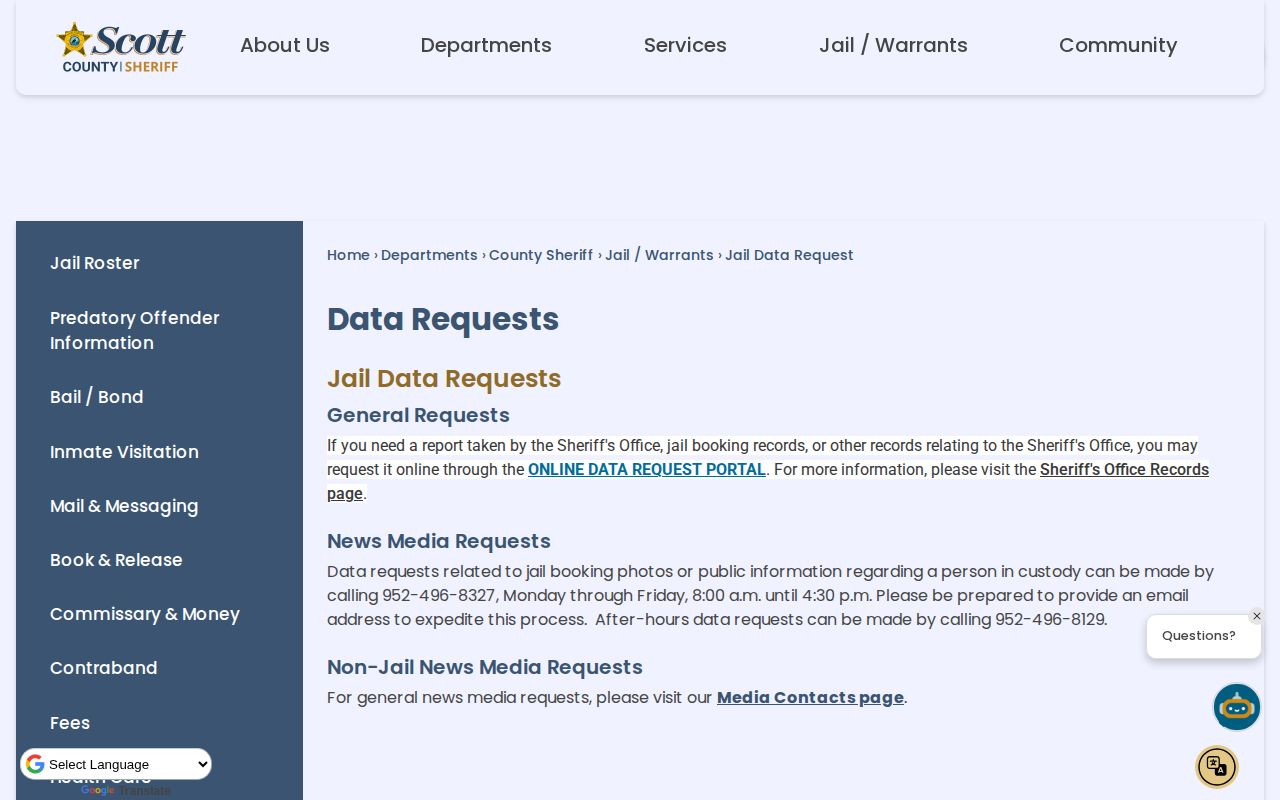
The captured county page supports the records fallback after a released person leaves the live roster.
Scott County Release Data Law
The Minnesota Government Data Practices Act starts from public access unless another state or federal rule classifies the data differently. Minn. Stat. § 13.03 governs access and copy-cost principles. Minn. Stat. § 13.85 governs corrections and detention data. It allows access to much confinement-created data while protecting categories such as medical, psychological, safety, security, financial, informant, and investigative information.
Scott County does not publish a retention period for a released-person roster because it does not publish such a roster. Its web feed is a current-custody view. Historical release proof must come from the maintained booking record, court file, or corrections record. Expungement in Minnesota generally seals covered records rather than destroying them. A blank online result may also reflect confidentiality, an older nonelectronic file, a retention schedule, remote-access limits, or a name mismatch. It is not proof that no booking or release occurred.
Request only the public release event. An entire unredacted correctional file is not automatically public.
Scott County Bond Release Timing
Scott County accepts cash or card bail in the jail lobby. Online payment is available through Access Corrections when the “Pay Bond” option appears, and the lobby accepts bonds from a Minnesota-approved licensed bail bondsman. The official Bail and Bond page directs inquiries to Jail Administration and asks callers to have the person’s full name and date of birth ready.
Payment completes only a financial or legal step. Jail staff may still need to match the court authority, finish processing, check other cases, and resolve warrants or holds. A receipt is not the actual release timestamp. Confirm departure with Jail Administration at 952-496-8314, then obtain the final event when time and destination matter. The county’s bond page also carries the practical local path shown below.
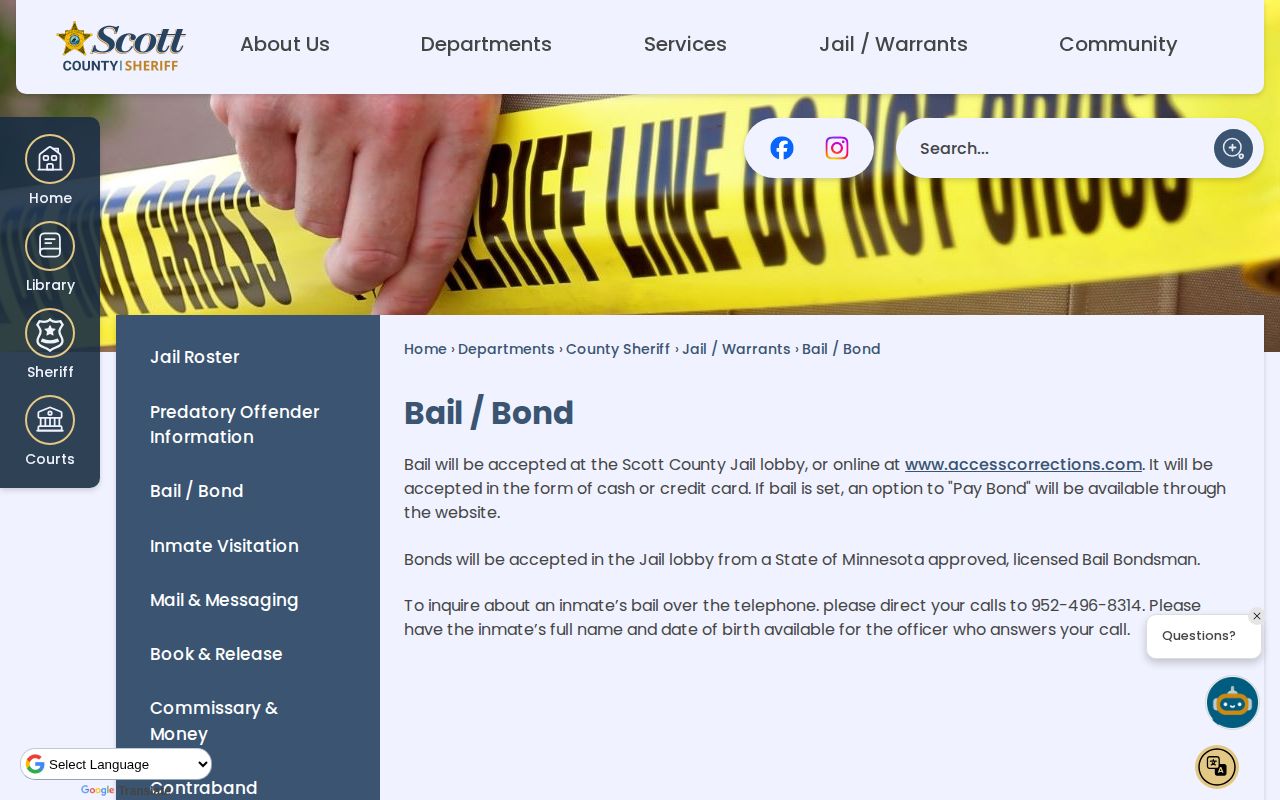
The county route explains payment options but does not replace the completed jail release record.
Scott County Release Property Pickup
An incarcerated person may sign a Release form authorizing family or friends to collect property before final discharge. One clothing set must remain with the person. Scott County directs authorized pickup to the jail lobby on weekdays from 8:00 a.m. to 4:30 p.m., and the collector must show government-issued identification. This is a third-party property transfer process. It does not document the last property handoff at discharge.
The Scott County property instructions should be checked before a trip because the signer, remaining clothing, pickup window, and identification rules all matter. Scott County does not publish the general final-release door, a family waiting zone, or a gate-money policy. Call Jail Administration before making pickup plans.
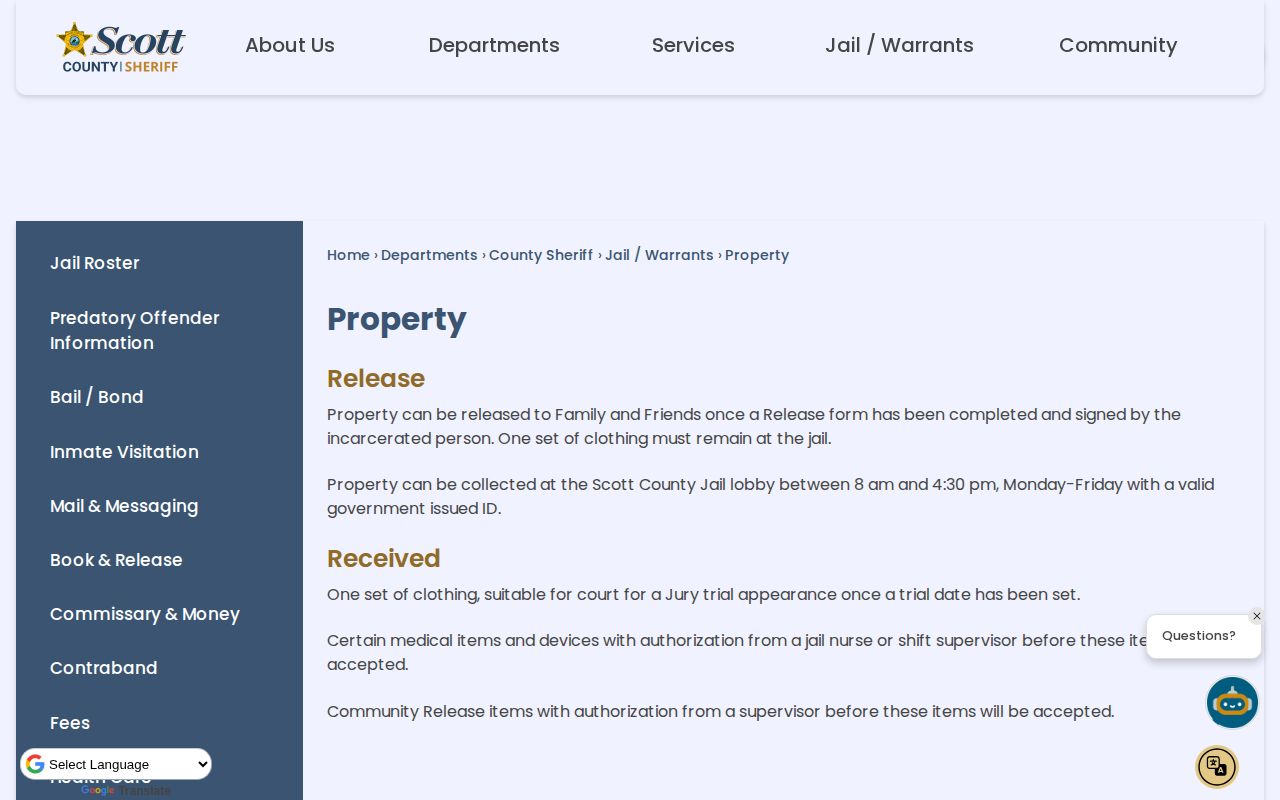
The official property page distinguishes an authorized pickup from proof that a person has left custody.
Scott County Release Program Fees
Scott County’s Community Release Packet lists fees for jail programs and sentenced custody. It includes different daily work-release rates for Scott and non-Scott sentences, a booking fee, drug-screen costs, pay-for-stay charges, and possible lab verification. These costs apply to the specified program or custody setting. They are not a fee for a public release record, and they are not a general price paid to secure freedom.
The distinction prevents two common errors. A data request may carry a copy estimate under the county’s data-practices procedure. Bail is a separate court-linked financial condition. Community Release program fees govern approved activity while the participant remains in jail custody. Each payment belongs to a different process, and none by itself proves the actual discharge time.
Find Scott County Released Inmates
Begin with the last known custody type. The Scott County roster answers whether a person is shown in the jail now. It does not provide a history of people who left. VINE can record a county-jail custody change. MCRO can show the court order, sentence, warrant, or discharge action. MNDOC covers a person committed to state prison who remains under Minnesota corrections jurisdiction. Federal and immigration systems answer narrower questions about their own custody.
- Check the timestamped Scott County “In Custody” feed and compare MNI, booking number, intake date, age, and charges.
- If the person is absent, search Minnesota VINE for the correct Scott County record. An Out of Custody event is useful but does not identify every transfer.
- Search MCRO by Scott County case. Use a court file or citation number when person-name search does not show the pending matter.
- Use the MNDOC Public Viewer if a prison commitment or supervised release may apply. Read Current Status before any projected date.
- Use BOP for federal imprisonment and ICE ODLS for current immigration detention. Neither replaces the county destination field.
- Request the actual Scott County booking and release record to settle the date, type, and receiving agency.
A name missing from the current roster proves only that it was not displayed when checked, not where the person went.
For the county’s same-day fallback workflow, the Released Last 24 Hours page explains why Scott County has no public release window and how to verify a recent departure.
Scott County Roster Release Limits
The exact Scott County feed labels itself “In Custody” and prints a generated date and time. It shows Photo, MNI, Name, Sex, Age, Booking Number, Intake Date, and Charges. Charge lines can contain severity, status or disposition, statute or case reference, and description. None of those columns is an actual release date, release time, release destination, or rolling recent-release window.
The official roster wrapper also warns that scammers target families connected to people in custody or recently released. The Sheriff’s Office says it will not call demanding payment. Verify a demand by independently dialing the published Jail Administration number rather than a number supplied by the caller.
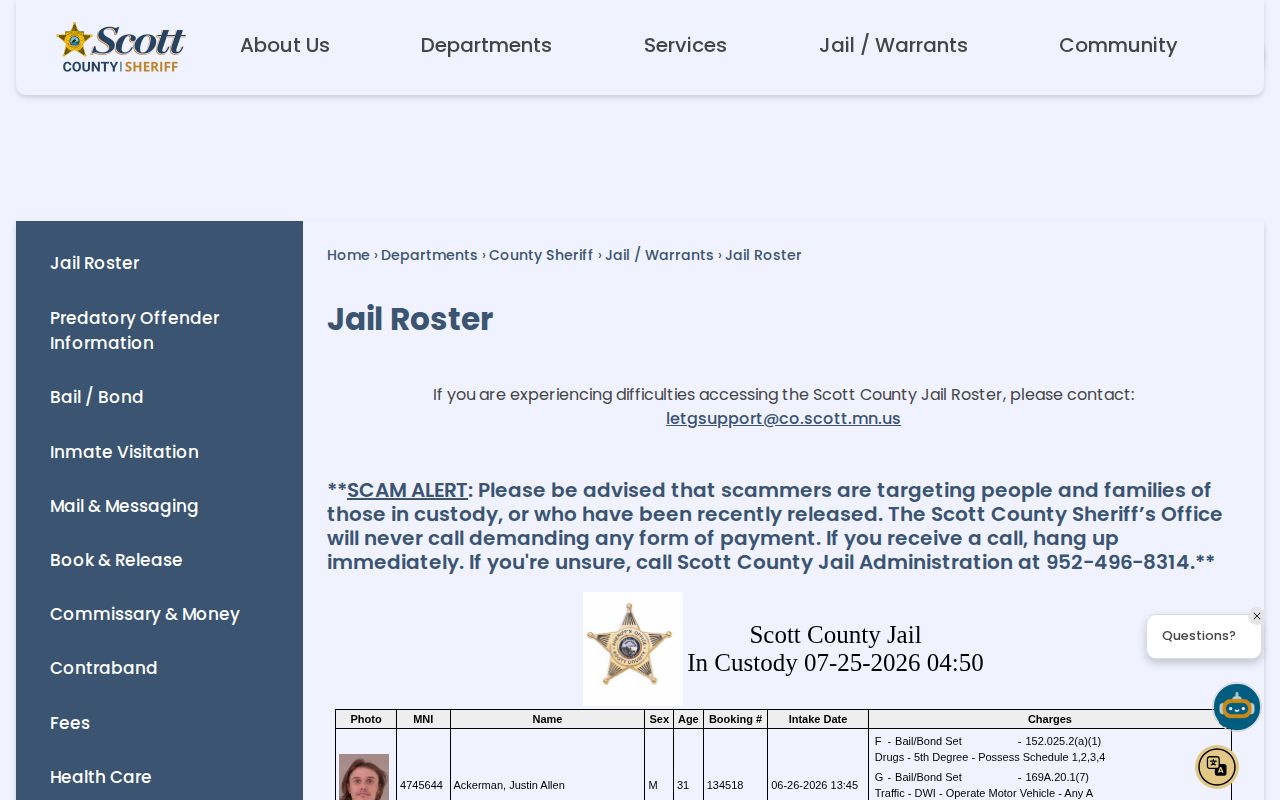
The county page confirms both the current-only scope and the local warning that matters after release.
Scott County MNDOC Release Search
The MNDOC Public Viewer covers adults committed to the Commissioner of Corrections who remain under state jurisdiction. Search by first and last name or the complete six-digit MNDOC Offender ID. Name search uses prefix matching and can include DOC name history and aliases. Match birth date, offense, sentence date, and court file instead of relying on a name alone.
Read Current Status first. “Incarcerated” plus a facility means the person has not left state prison. “Under Supervision” or “Under Intensive Supervised Release,” together with its effective date and supervising unit, confirms movement into the community phase while DOC jurisdiction continues. Anticipated Release Date is a projection. Expiration Date is the end of sentence jurisdiction and is not automatically the prison departure date.
| Viewer field | How to read it |
|---|---|
| MNDOC Offender ID | Complete six-digit state identifier |
| Current Status and effective date | Current prison or supervision phase |
| Facility or supervising unit | Institution or community office responsible |
| Anticipated Release Date | Prospective prison-release calculation |
| Expiration Date | Expected end of DOC jurisdiction |
| Agent and court file | Supervision contact and linked legal matter |
The official Minnesota offender search screen shows the correct statewide starting point.
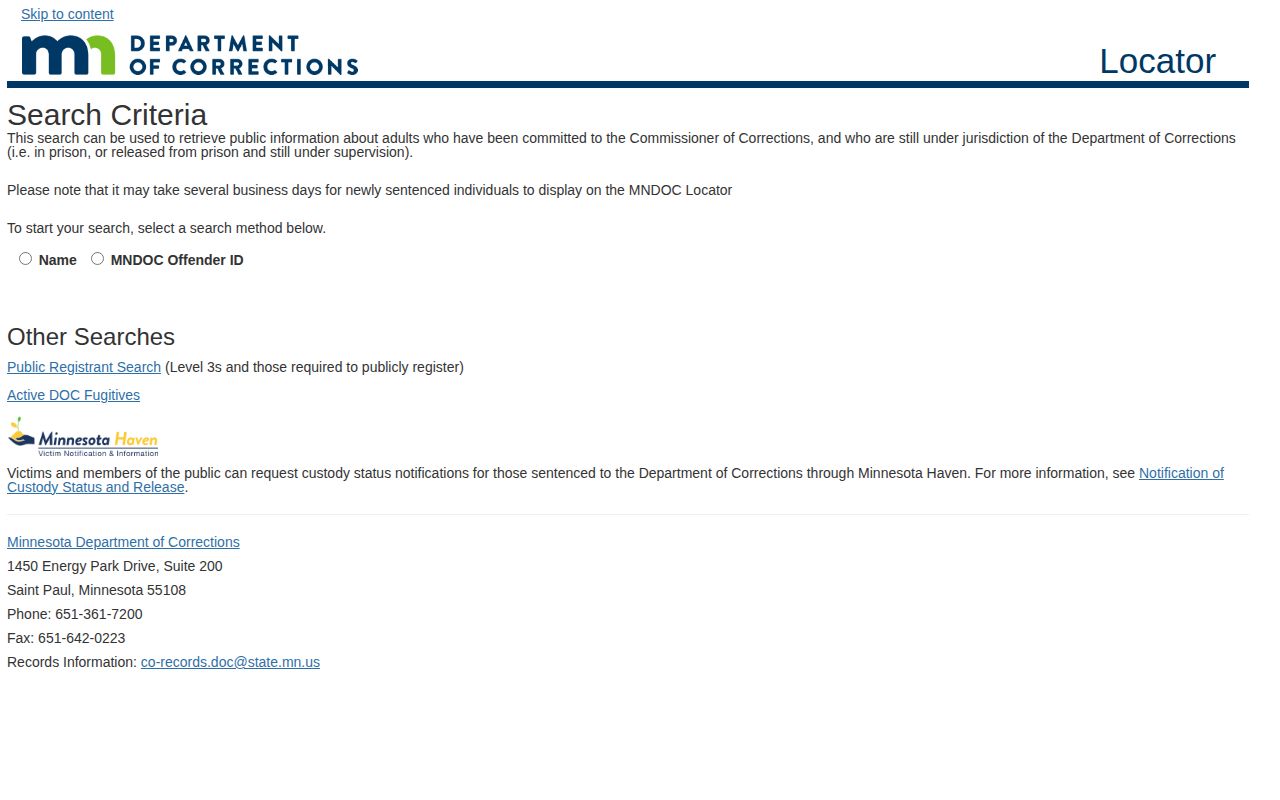
A county-jail-only sentence may never appear there, while a fully discharged person may require an MNDOC Records Management request.
Scott County Court Release Search
Minnesota Court Records Online can preserve the case path after a person drops from the jail roster. Review the Register of Actions, charges, disposition, bond or release order, sentencing order, warrants, and later probation discharge. Court data explains the legal authority. It usually does not certify the time the jail completed physical release.
A Scott County case has a key remote-search limit. The MCRO FAQ says a pending criminal matter does not appear through person-name search until a conviction exists under the court’s definition. Dismissed and continued-for-dismissal matters share that limitation. Use the case number, citation number, name variants, wildcard tools, or a courthouse public terminal. The terminal can provide broader electronic district-court access than the remote site.
The official MCRO overview identifies the statewide court-search route.
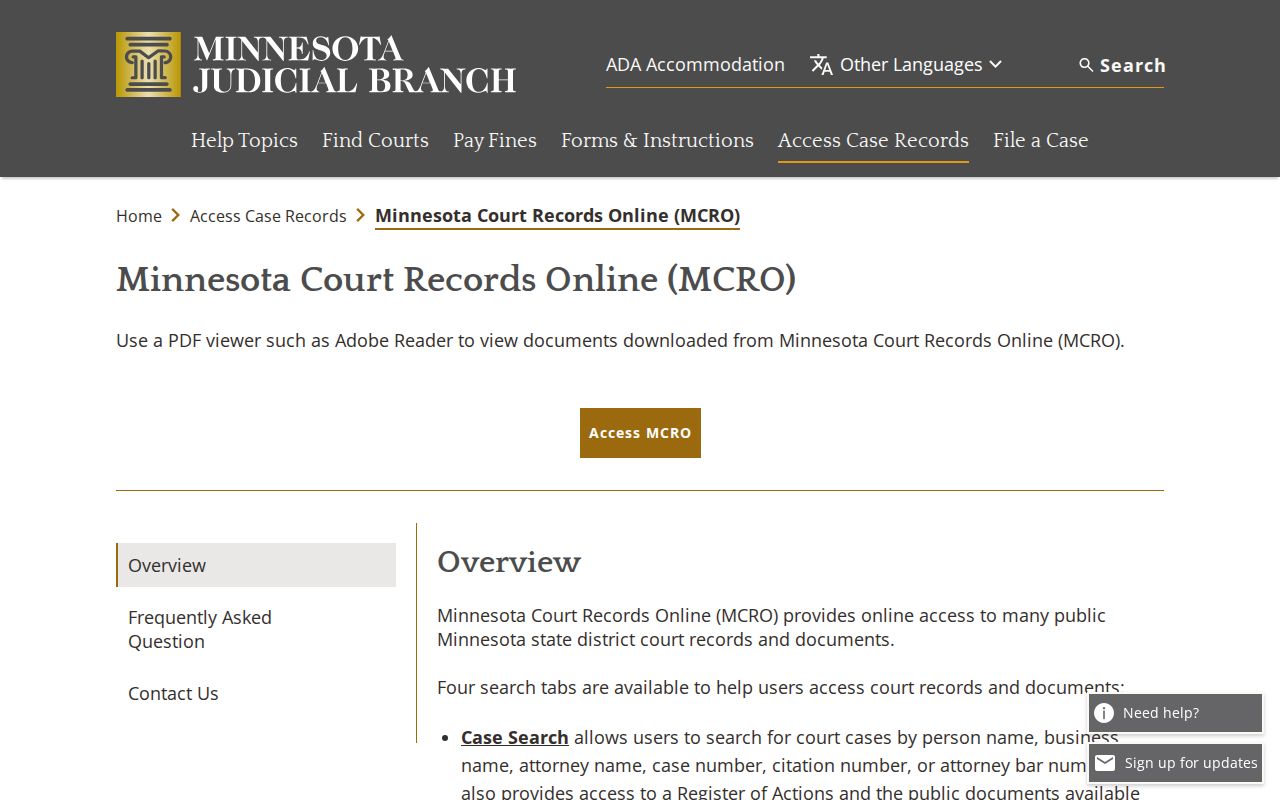
Scott County Court Administration can provide permitted copies when remote results or documents are incomplete.
Scott County Release Supervision
Probation is a court-ordered sentence in the community. Supervised release is the community portion of a state prison sentence. Scott County Community Corrections handles local probation, conditional-release work, transfers, and some people released from MNDOC prison under supervision. A Scott County conviction does not guarantee local supervision because residence and approved transfer rules may place the case elsewhere.
Scott County reports a coordination-of-care model linking a jail social worker, a revised Jail Re-entry Probation Officer role, and jail programs. County performance materials describe help with treatment placement, other-county warrants, release planning, and service navigation. Monthly client measures and quarterly contact measures show active local transition work, but the sets should not be added into one annual count because people and contact types can overlap.
- Probation
- Court supervision that may occur instead of or after confinement.
- Supervised release
- The community phase of a Minnesota prison sentence while DOC jurisdiction continues.
- Discharge
- The legal end of the relevant sentence or supervision, shown by an order or corrections record.
- Detainer
- A request or basis for holding or transferring someone for another authority.
Scott County Release System Boundaries
Minnesota VINE is the current county-jail notification layer. Search the selected Scott County record by name or booking identification, review custody status, and register for release or transfer notices. Minnesota Haven is the separate MNDOC prison and supervision notification program. These two state services should not be merged. A VINE Out of Custody event means the county feed recorded a change, not that all state or federal custody ended.
The BOP Inmate Locator covers federal prisoners generally from 1982 forward. Read Release Date with Location. “Released” or “Not in BOP Custody” answers a federal custody question only. ICE ODLS searches current immigration detention, not historical county release. A generic Scott County “Hold for Another Agency” entry must not be labeled as ICE without the actual record. The county release destination is the key bridge between systems.
Can one person look released and confined? Yes. Scott County may report Out of Custody after a transfer while MNDOC, BOP, another jail, or ICE records a new or continuing custody status.
Scott County Jail Release Pickup
The Law Enforcement Center’s public entrance is on the north side, nearest Third Avenue West and Fuller Street. Scott County does not say that this public entrance is the final discharge exit. It also does not publish general release hours, a weekend or holiday procedure, or a family waiting area. Call Jail Administration at 952-496-8314 before planning a ride or waiting at the building.
Community Corrections links the Minnesota Valley Transit Authority trip planner as a broad local resource, but that link does not prove that a specific route or stop serves the jail at a needed time. Approved transportation rules in the Community Release Packet apply to people making temporary program trips while still in custody. They are not a published policy for final release rides.
Note: A public entrance, property pickup window, and approved program route describe different events and should not be treated as one discharge procedure.
Scott County Release Status Sources
Each official system supports a narrow statement. The current jail roster supports “listed in Scott County custody at the feed time.” A jail release event supports “Scott County ended this booking at the recorded time.” VINE supports “the selected county feed changed the person’s custody state.” An MNDOC supervision status supports “the person left state prison and remains under DOC jurisdiction.” BOP and ICE results speak only to their federal systems.
| Question | Correct source | Limit |
|---|---|---|
| Still in Scott County Jail? | Current “In Custody” roster | No release history |
| When and how did county custody end? | Booking and release record | Public fields may be redacted |
| Did the county feed report departure? | Minnesota VINE | Transfer destination may be absent |
| Released from state prison? | MNDOC Current Status | Only while within viewer scope |
| What did the court order? | MCRO and court copies | Not the jail-door timestamp |
Scott County Release Facility
The Scott County Jail is the one adult detention facility identified for this county’s public released-inmate workflow. The Sheriff’s Office operates it in the Law Enforcement Center. A person may return to the community, remain in custody during approved community-release activity, or transfer to another authority. The jail release record identifies the path.
Scott County’s Juvenile Alternative Facility is deliberately excluded. Juvenile detention information is restricted and does not belong in an adult public release search. No state prison, BOP prison, permanent ICE detention facility, or documented contracted ICE jail was identified in Scott County. A state or federal transfer must be traced through the record and the correct receiving system.