
Scott County Parole and Probation
Minnesota most often uses the term supervised release for the community part of a modern felony sentence. A person can leave a state prison and still remain under Minnesota Department of Corrections jurisdiction. The MNDOC record may say “Under Supervision” or “Under Intensive Supervised Release,” give an effective date, and name a district, Community Corrections agency, or agent. That is different from final discharge, which ends sentence jurisdiction.
Probation starts with a court order. Scott County District Court may impose it after a stayed or local sentence, and Scott County Community Corrections may supervise it. Conditional release is different again. It can monitor court-ordered terms while a criminal case is still pending. The office that handles a case can also change when a person moves and an approved transfer places supervision in another county.
| Record type | How it begins | Best public verification |
|---|---|---|
| Supervised release | Community phase after an MNDOC prison term | MNDOC Public Viewer status and effective date |
| Probation | Scott County District Court sentence | MCRO sentence, conditions, and discharge entries |
| Conditional release | Court terms while a case is pending | Court order and Scott County Adult Services |
| Final discharge | Legal end of sentence jurisdiction | Expiration or discharge record, not missed appointments or silence |
- Supervised release
- The part of a prison sentence served in the community under corrections control.
- Probation
- A court-ordered community sentence with rules and oversight.
- Absconder
- A supervised person alleged to be evading authorities after a violation.
- Discharge
- The formal end of the sentence or supervision obligation.
Verify Scott County Post-Release Supervision
The verification route depends on the sentence. The secure Statewide Supervision System, known as S³, contains broad probation and corrections data, but it is restricted to criminal justice professionals. It is not a public lookup. The public routes are the MNDOC Public Viewer for a state-prison sentence and Minnesota Court Records Online for a Scott County court case. Neither source should be read in isolation.
- Determine whether the person served a state-prison term, received county probation, or is on pretrial conditional release.
- For a prison case, search the complete six-digit MNDOC Offender ID or the person’s first and last name. Match birth date, offense, sentence date, and court file.
- Read Current Status and its effective date. “Under Supervision” confirms the community phase; an Anticipated Release Date alone does not.
- For probation, open the Scott County case in MCRO and review the sentence, probation order, Register of Actions, warrants, and any later discharge.
- Use the named MNDOC unit or Scott County Community Corrections contact to clarify the office route. Staff may not disclose protected case details.
If the state result is missing, MNDOC Records Management accepts historical offender-record requests through its offender records request page. Ask for the existing supervision effective date, supervising unit, expiration date, and final discharge. For county probation, the court file is the public starting point because the local office is a supervision and service agency, not a public person-search portal. The broader Scott County released inmate search explains how to trace the custody event that came before supervision.
Scott County Probation Office Routes
Scott County Adult Services separates conditional release, probation intake, adult probation, a Probation Service Center, and transfers. Probation intake follows a court order and assigns the person to a unit or officer. Adult Probation handles misdemeanor, gross-misdemeanor, and felony probation as well as some people released from MNDOC prison. A Scott County conviction does not guarantee that the local office supervises the case. Residence and transfer rules can place it elsewhere.
Scott County Community Corrections / ProbationGovernment Center West
200 Fourth Avenue West
Shakopee, MN
Phone: 952-496-8260
Fax: 952-496-8469
Adult Conditional Release can be reached at 952-496-8295. The Probation Service Center uses 952-496-8467, and Minnesota Monitoring uses 952-496-8705. These lines help route a matter to the right program. They are not substitutes for the official court order or MNDOC status, and they do not guarantee that private supervision details will be released by phone.
A transfer deserves special care. Scott County says transfer into or out of the county requires eligibility and compliance and may be denied. The place of conviction, place of residence, and current supervising office can therefore differ. When an MNDOC detail names a Community Corrections unit, use that named unit. When a court file orders probation but does not identify the current office, begin with Scott County intake and provide the court file number. This avoids treating a local sentence as proof that Scott County still holds the active supervision file.
The county Adult Services source shows how conditional release, probation, and supervised release are divided locally.
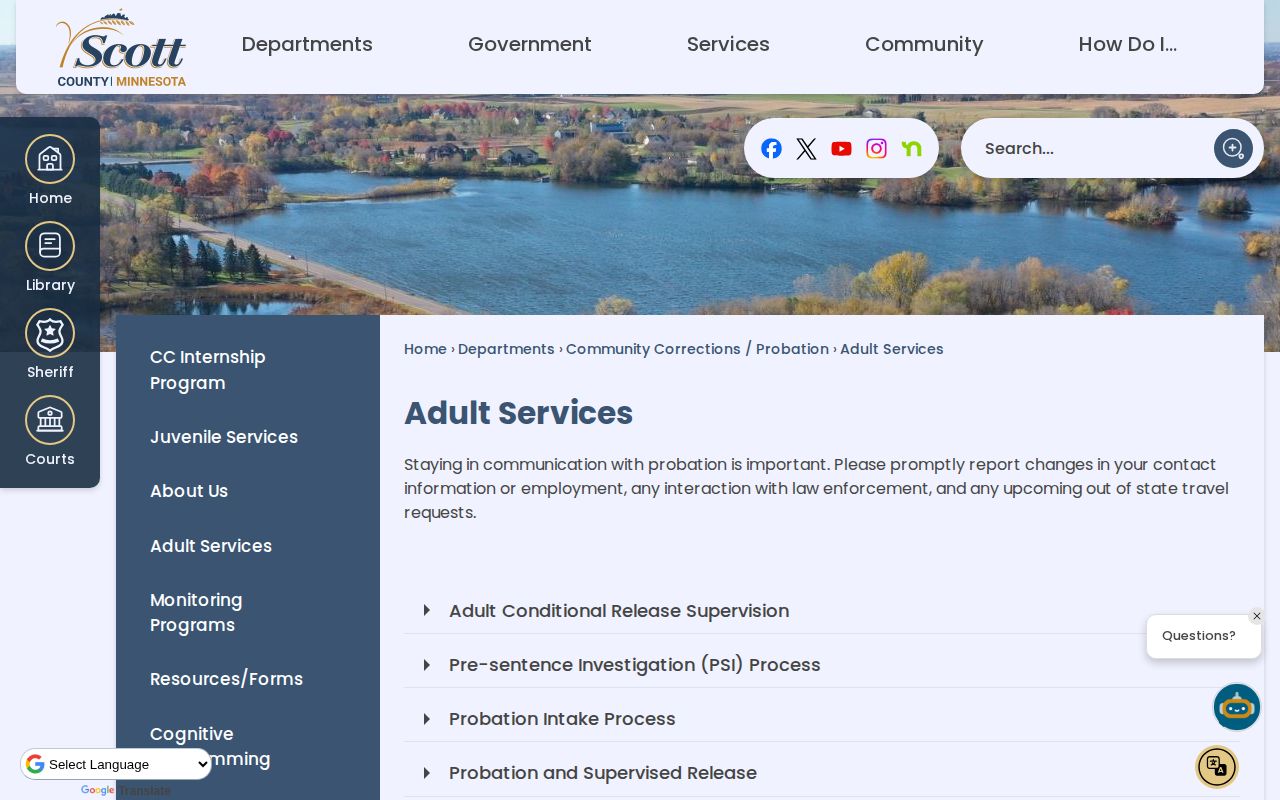
That local division helps identify which office may hold the active file after a jail or prison release.
Scott County Supervised Release Board Cases
The Minnesota Department of Corrections Supervised Release Board began its current role in 2024. It does not conduct a parole hearing for every state prisoner. Its limited scope includes specified life or indeterminate sentences, certified adults, certain criminal-sexual-conduct cases, juvenile long sentences, and other categories assigned by law. Most ordinary determinate felony sentences follow the statutory supervised-release structure and are checked through the MNDOC status record.
For an eligible Board case, use the official hearing calendar hub for current agendas and approved minutes. Minutes are the published results channel found in the official source review. A Board action may set a projected date, continue a matter with required steps, grant release when authorized, or deny it. The MNDOC person record must still be checked afterward because a decision and an effective custody change are separate events.
Eligibility depends on sentence terms, offense, and date. It cannot be reduced to one minimum for all life cases. The strongest proof of current supervision is the status record after action, while minutes document what the Board decided.
Written public statements use the Board’s official submission route. Victim-response questions can go to the Life Sentence Victim Response Coordinator at 651-361-7100 or MNParoleInput.DOC@state.mn.us. Those channels concern eligible Board cases. They are not the route for an ordinary Scott County probation file or every determinate supervised-release sentence.
Scott County Warrants and Absconders
An active warrant and an absconder status are not the same record. MNDOC describes a fugitive as a person in the community portion of a sentence who is alleged to have violated terms and is evading authorities. The department’s search and fugitive routes provide the state-level check, and its fugitive tip line is 651-603-0026. A fugitive listing shows wanted status. It does not show successful completion or final discharge.
Scott County did not publish a name-based local probation-absconder list in the official source sweep. Local warrant information is telephone-based through Jail Administration at 952-496-8314. A warrant issued elsewhere in Minnesota must be checked with the issuing jurisdiction. The court Register of Actions may also show a warrant event, but live status should be confirmed with the responsible office.
The local warrant rule also affects jail community release. Scott County’s Community Release Packet says an active warrant or hold in any jurisdiction makes a person ineligible for that temporary program. Community release allows approved activity outside the jail while the participant remains in custody. It is not parole, probation discharge, or final release.
Note: A warrant entry supports a precise statement about wanted status, not a broad claim that every form of supervision has ended or resumed.
Scott County Release Reentry Coordination
Scott County has a local coordination-of-care model that joins a jail social worker, a revised Jail Re-entry Probation Officer role, and jail programs. The 2024 Performance Report describes monthly unique-client measures, while the county’s later performance packet tracks both client and other reentry contacts by quarter. The figures use different measures and should not be added into a single annual head count.
The work includes treatment placement, warrant resolution, release planning, and navigation to services. This local process matters because leaving Scott County Jail can create several supervision paths. One person may report to local probation, another may transfer supervision, and a third may move from state prison into an assigned MNDOC or Community Corrections unit. The reentry function helps coordinate that transition, but it does not replace a court order, an MNDOC status, or a formal discharge record.
A reader trying to reconnect with someone should first verify the current legal status and office. Then the relevant program contact can be used for permitted service navigation.
Scott County Supervision Through Discharge
Supervision conditions come from the court, corrections authority, and individual case. Scott County describes tools such as GPS, alcohol monitoring, testing, and no-contact orders in its conditional-release work. A violation can lead to a report, warrant, added restriction, or revocation process. The exact consequence must come from the governing order and official record, not from a general description of the program.
Completion also needs a record. County probation may end with a discharge, satisfaction, or order in the court Register of Actions. State supervised release may move into supervision abatement under the Minnesota Rehabilitation and Reinvestment Act. Abatement can reduce active reporting after earned compliance, but it is not final discharge. The legal expiration date and specified duties remain until the sentence ends.
Use the expiration or final-discharge record before stating that Scott County parole or probation is over. A person can have few routine contacts yet remain under jurisdiction, just as a person can be outside the prison building while still serving the community portion of a sentence.