
Scott County Projected Release Dates
A projected date estimates when a sentenced person may leave an institution under the rules currently applied to that sentence. Minnesota Department of Corrections calls its public field Anticipated Release Date. It is not an executed release event. Current Status and the status-effective date show whether a state prisoner actually moved from incarceration into supervised release.
An actual jail release record answers a different question. It should identify when Scott County custody ended and why, such as bail, recognizance, court order, time served, sentence completion, or transfer. A person can leave the jail yet remain in custody after transfer to MNDOC, another county, federal authorities, or another agency. Court records explain the legal order but may not show the physical door time.
A pretrial detainee has no sentence-based release date to calculate. The next event may depend on bail, the court, and any other hold. A sentenced person usually has a calculation, but even then the public date can change before release.
Find Scott County Inmate Release Dates
Start with custody type. Scott County Jail and MNDOC keep different records, and the state viewer does not replace the jail. A person sentenced only to county jail may never appear in the MNDOC Public Viewer. A person committed to state prison may disappear from the county roster because of transfer, not community release.
- Check whether the person is in Scott County Jail, an MNDOC prison, or another system. The county’s live roster is labeled In Custody and does not show a released list.
- For state prison, open the MNDOC Public Viewer. Search by first and last name or the complete six-digit offender ID.
- Match birth date, offense, sentence date, and court file. Then read Current Status before reading Anticipated Release Date or Expiration Date.
- For a county sentence, review the sentencing order in MCRO and contact Scott County Jail Administration or Sheriff Records for the jail calculation.
- For a pretrial case, read bond, release, warrant, and hold entries. Do not create a date from the next hearing or bond amount.
- Confirm the actual event through MNDOC status or the county booking and release record.
The official MNDOC detail example demonstrates the exact Anticipated Release Date field on a live state record.
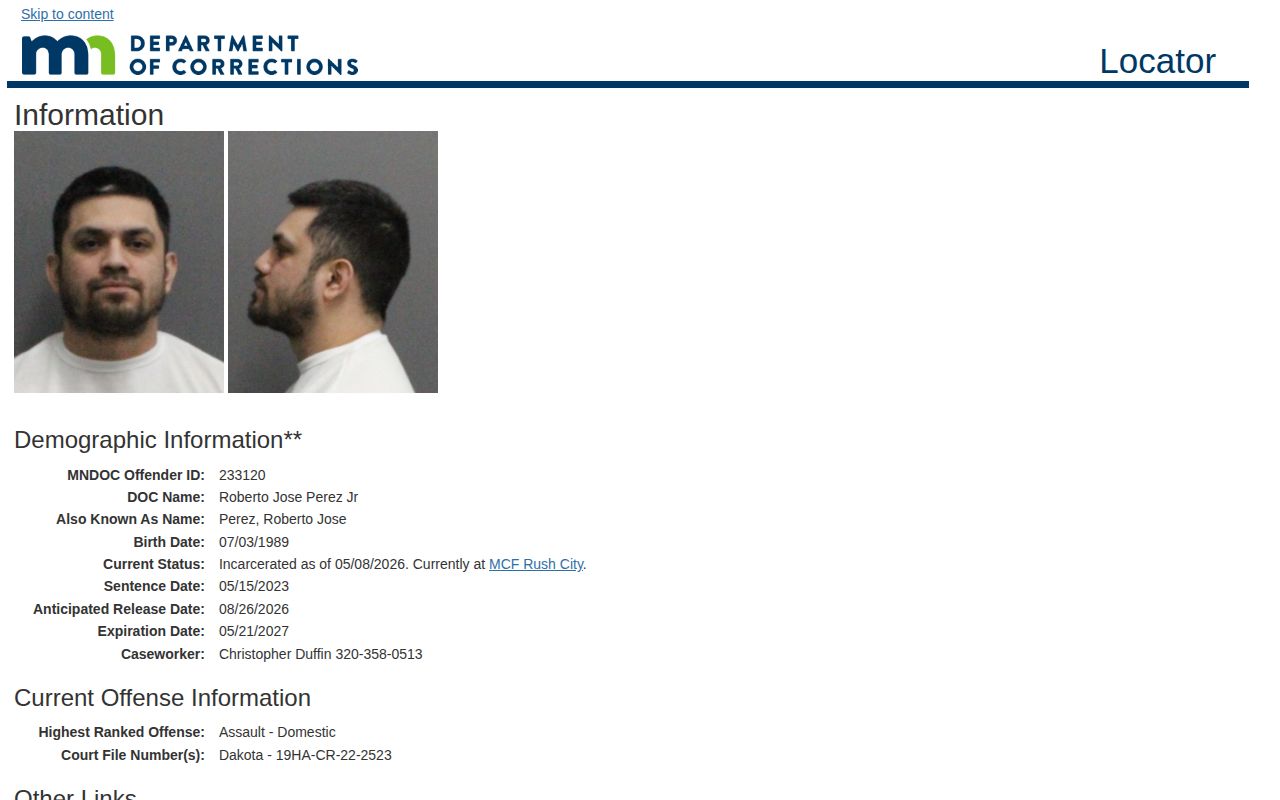
The field must be paired with Current Status because the projection alone cannot confirm that release occurred.
If the viewer has no result, request historical information from MNDOC Records Management. A fully discharged person may fall outside the viewer’s stated scope. A new prison commitment can also take several business days to appear.
Scott County Release Date Fields
Three state fields are easy to confuse. Anticipated Release Date is prospective. Current Status and its effective date can confirm the move to “Under Supervision” or “Under Intensive Supervised Release.” Expiration Date is the end of DOC sentence jurisdiction, not automatically the day the person left prison. The supervising unit or agent can also show where the community phase is managed.
| Field | Meaning | Common mistake |
|---|---|---|
| Anticipated Release Date | MNDOC’s current prison-release projection | Reporting it as an event that already occurred |
| Current Status | Incarcerated or in a named supervision phase | Ignoring the status-effective date |
| Expiration Date | Projected or recorded end of DOC jurisdiction | Calling it the prison exit date |
| Actual jail release time | Booking-level end of Scott County custody | Substituting a charge status or court time |
| Receiving agency | Destination after a transfer | Calling all jail departures community release |
For the county jail, ask for the actual release or discharge date and time, release authority, destination, receiving agency, and public hold information. A charge row marked Sentence Complete is not enough. Another charge, warrant, or detainer can keep the person in custody after one sentence component ends.
Scott County’s current roster provides MNI, booking number, intake date, and charges for a person still listed. Save those identifiers before making a narrow request. They help Sheriff Records locate the right custody episode when names repeat or a person has several bookings. The county publishes no general release-record turnaround or fixed copy price, so request an estimate and electronic delivery when appropriate rather than assuming a deadline or fee.
The broader Scott County release-record lookup explains the county request fields and court checks used after a person leaves the live roster.
Minnesota Release Timing for Scott County
Minnesota does not use a blanket federal “serve 85 percent” rule. For many felony offenses committed on or after August 1, 1993, Minn. Stat. § 244.05 divides a fixed executed sentence into imprisonment and supervised release. The supervised portion generally equals one-third of the sentence, with adjustments allowed by law. This is often described as about two-thirds in prison and one-third under supervision, but it is not a safe personal calculator.
The community portion is still part of the sentence. Disciplinary confinement and refusal of required programming can delay the move to supervised release. Offense date and type, mandatory minimums, consecutive sentences, court amendments, jail credit, and special statutes can also change the calculation. Some cases within the Minnesota Supervised Release Board’s limited jurisdiction follow Board action rather than the ordinary path.
The official supervised-release statute shows the imprisonment, supervision, and calendar rules used in Minnesota.
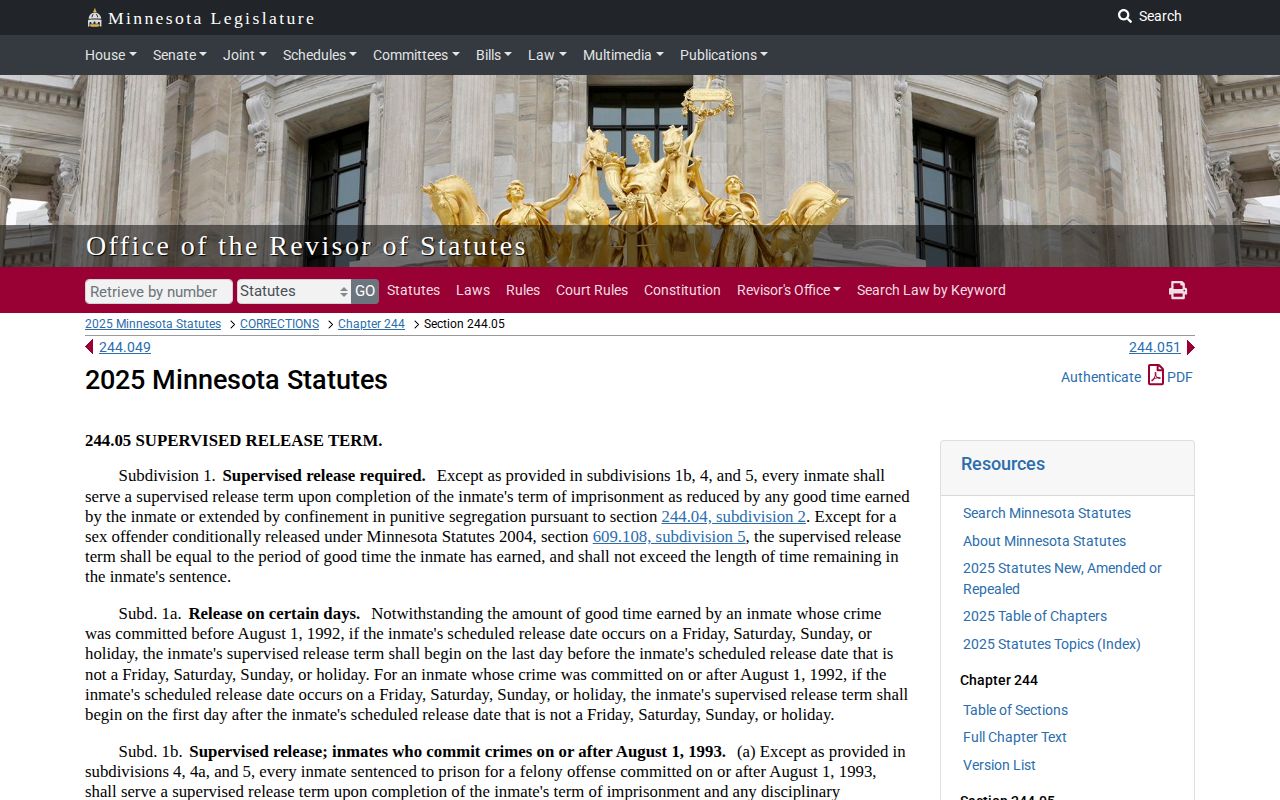
The statutory framework explains why prison departure and final sentence expiration are separate dates.
Older convictions may fall under older good-time provisions in Minn. Stat. § 244.04. Do not apply the modern one-third structure backward. The correct approach is to obtain the actual MNDOC sentence calculation for the identified record.
Scott County Earned Release Credit
The Minnesota Rehabilitation and Reinvestment Act adds Earned Incentive Release Credit, or EIRC, for eligible people who meet objectives in an individual rehabilitation plan. Under Minn. Stat. § 244.44, credit is used in the imprisonment calculation. It is not added to the supervised-release term, whose total length remains unchanged.
Current law permits credit up to 17 percent of the total executed sentence and does not allow it to reduce imprisonment below one-half of that sentence. Specified facility-rule violations or criminal acts can lead to revocation. Life sentences, specified indeterminate sentences, and people governed by older frameworks can be excluded under § 244.45. Eligibility therefore cannot be inferred from one projected date.
The EIRC statute page supplies the official credit limits and revocation framework.
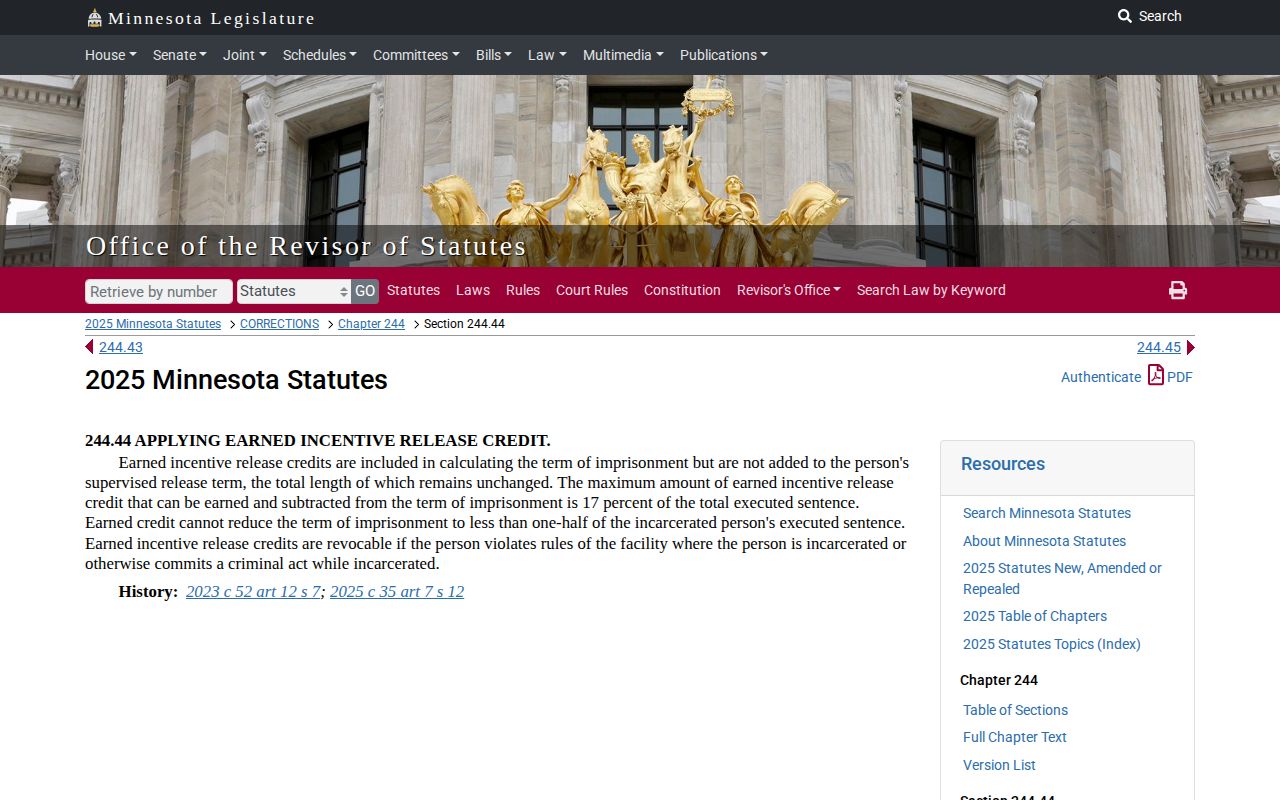
The statute confirms that earned credit changes the imprisonment calculation without erasing the community supervision portion.
These provisions are in active implementation. Use the current Revisor text and the latest MNDOC record when a date matters. A stale screenshot or old estimate should never displace the live status and official calculation.
Scott County Weekend Release-Date Rule
Minnesota has a state-prison calendar rule that can feel counterintuitive. For covered crimes committed on or after August 1, 1992, when the scheduled supervised-release date falls on Friday, Saturday, Sunday, or a legal holiday, release begins on the first following day that is not one of those days. The older pre-August 1992 rule uses the last preceding eligible weekday.
This rule comes from § 244.05, subd. 1a. It applies to the state-prison supervised-release calendar. It does not prove how Scott County Jail processes a final discharge on weekends or holidays. The county has not published a general final-release schedule, so call Jail Administration and request the actual event instead of importing the prison rule into a county sentence.
Scott County adds a separate local issue. Its community-release material says reporting under the influence, contraband, or disciplinary violations can delay program privileges and cause loss of accrued good time. Those rules concern the county community-release program and local sentence administration. The county publishes no universal jail good-time percentage that can be used as a formula for every inmate.
The state weekend rule, the county program consequence, and the final jail calculation must remain separate. Each comes from a different authority and answers a different date question.
Why Scott County Release Dates Change
A date can move even when the original sentence remains in place. Some changes reflect credits or discipline. Others come from courts or outside agencies. The latest official calculation should be paired with the source date, since an earlier projection can become stale without warning.
| Factor | Possible effect | Best confirmation |
|---|---|---|
| Jail credit correction | Changes time credited before prison | Sentencing order and MNDOC calculation |
| Consecutive or concurrent structure | Changes how multiple terms combine | Court judgment and DOC record |
| Earned credit | May shorten eligible imprisonment | Current MNDOC calculation |
| Disciplinary confinement | May delay supervised release | MNDOC status and records |
| New court order | Can amend sentence information | MCRO and corrected DOC entry |
| Warrant or hold | Can block community departure or cause transfer | Jail release destination and issuing agency |
| Board action | Can set, continue, grant, or deny eligible release | Approved minutes and later Current Status |
A projected date should be stated with its source and access date. Then check again near the expected event. A person may have a court-authorized release yet remain while the jail processes another hold, or may leave one facility for another without returning to the community.
Confirm Scott County Actual Release
For state prison, read Current Status on or after the anticipated date. “Under Supervision,” with an effective date and unit, confirms departure into the community portion of the sentence. If the record disappears or stays unclear, contact MNDOC Records Management at 651-361-7330 or CO-Records.DOC@state.mn.us and ask for the existing institutional release and sentence-calculation records.
For Scott County Jail, contact Jail Administration at 952-496-8314 and use the Jail Data Request process for the actual event. Sheriff Records is at 301 Fuller Street South, second floor, Shakopee, and can be reached at 952-496-8300 during its published weekday office hours. Ask for the booking-level date, time, release type, and destination.
MCRO can support the request with a court file number and the order that authorized release or set the sentence. Remote name search has limits for pending criminal matters, so use the case or citation number when known. The court record may explain why the person became eligible to leave, but the jail remains the source for the completed release time and any transfer.
Minnesota VINE can provide a county-jail status change and alert. The VINELink Release Check explains registration and the separate Minnesota Haven route for state-prison notices. An alert is timely evidence, but the originating jail or DOC record remains the final source for the kind of release and where the person went.
Note: A past projected date without a matching status change is a reason to verify, not proof that the release occurred.